Biocracked
←

#insulin sensitivity

2 articles
Approach: Macro science. Palette: D, bold color field.

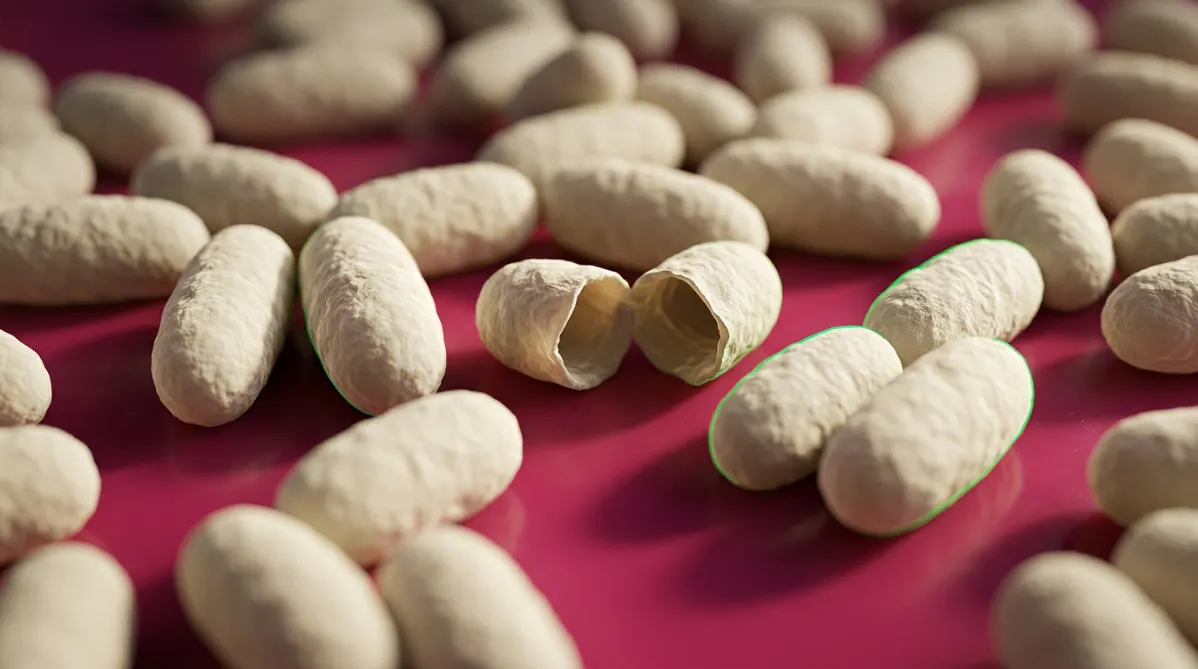
Extreme close-up microscopy-style photograph of a dense cluster of oval, rod-shaped bacterial cells, rendered as slightly wrinkled, matte, pale cream-white forms with visible surface texture. They rest on a smooth, saturated magenta-pink gel surface. Several cells in the foreground are crisp, while the rest fall into soft shallow depth of field. One cell near the center is split open and visibly hollow, to suggest a dead, heat-treated organism. Camera is a low three-quarter angle, as if through a scanning microscope. Lighting is a single hard, warm-white side light that casts short crisp shadows and creates bright rim highlights. A thin electric green (#00e676) line of reflected light traces the edge of one cell. The mood is stark, curious and quietly skeptical. There is no text and no labels.
metabolism

Das Darmbakterium, das tot besser wirkt: Akkermansias 29 %-Vorteil

BY HELIX WARD ·

In der ersten Humanstudie zu *Akkermansia muciniphila* zeigte die pasteurisierte (wärmeabgetötete) Variante, nicht die lebende, die besten Ergebnisse. Die Insulinsensitivität stieg um 28,62 % und das Nüchterninsulin fiel um 34,08 % gegenüber Placebo bei übergewichtigen, insulinresistenten Erwachsenen. Die erhofften Veränderungen im Gewicht und Fettanteil erreichten jedoch keine statistische Signifikanz, und mehrere Autor*innen halten Patente und haben ein Unternehmen gegründet, das das Bakterium vertreibt. Hier erfährst du, was die Studie gezeigt hat, was sie nicht aussagen kann und worauf du achten solltest, bevor du ein Supplement kaufst.
A softly lit editorial still life on a pale oat-colored linen surface, shot from a slightly elevated three-quarter angle in a wide landscape frame. At center-left, a small matte white ceramic dish holds a modest pile of fine off-white powder, with a tiny brushed-brass measuring spoon resting beside it. Next to the dish stands a minimalist amber glass supplement bottle with a plain cream label and no readable text. A few capsules spill casually across the linen, some translucent and some opaque ivory.

On the right side of the composition, a ripe blood orange cut in half and a handful of raw almonds sit on a light ash-wood board. A sprig of fresh rosemary adds a muted green accent. A sheer glass of water catches the light and throws a soft, rippled caustic pattern across the fabric.

In the background, out of focus, a woman's hand in a soft sage-green knit sleeve rests near a ceramic mug. This suggests a calm morning routine without showing a face. Behind her, a tall window casts diffused, golden-hour light from the upper left, with gentle shadows and a creamy, shallow depth of field.

The palette is warm and restrained: oat, ivory, terracotta, sage, and amber, with a single pop of coral from the blood orange. A thin, abstract line of muted terracotta paint, like a brushed arc, sweeps across the upper right background. It subtly evokes a rising curve without becoming a literal chart.

The mood is calm, trustworthy, and contemporary, like a premium wellness and science journal feature. The image has crisp focus on the powder and bottle, natural film-like grain, soft contrast, and generous negative space in the upper third for headline overlay. It looks like a high-end editorial photograph with no text, logos, or futuristic elements.
metabolism

Erster menschlicher Triumph von NMN: 250 mg pro Tag steigern die Muskelinsulinsensitivität um etwa 25 % bei prädiabetischen Frauen

BY DR. SYNAPSE ·

NMN ist seit Langem ein Favorit im Longevity‑Markt, doch belastbare Humanstudien fehlten – bis zu einer Washington‑Universität‑Studie, die 2021 in *Science* veröffentlicht wurde. Bei übergewichtigen bzw. fettleibigen, prädiabetischen, postmenopausalen Frauen verbesserte eine tägliche Dosis von 250 mg NMN über zehn Wochen die Muskelinsulinsensitivität um rund 25 %. Auch die Insulinsignale im Muskel und Gene, die mit der Muskelerneuerung zusammenhängen, zeigten Verbesserungen, während die Placebogruppe unverändert blieb. Der Nutzen war jedoch stark begrenzt und die Studie zeigte weder einen Rückgang des Blutzuckers noch eine Umkehr des Prädiabetes.

This page is available in